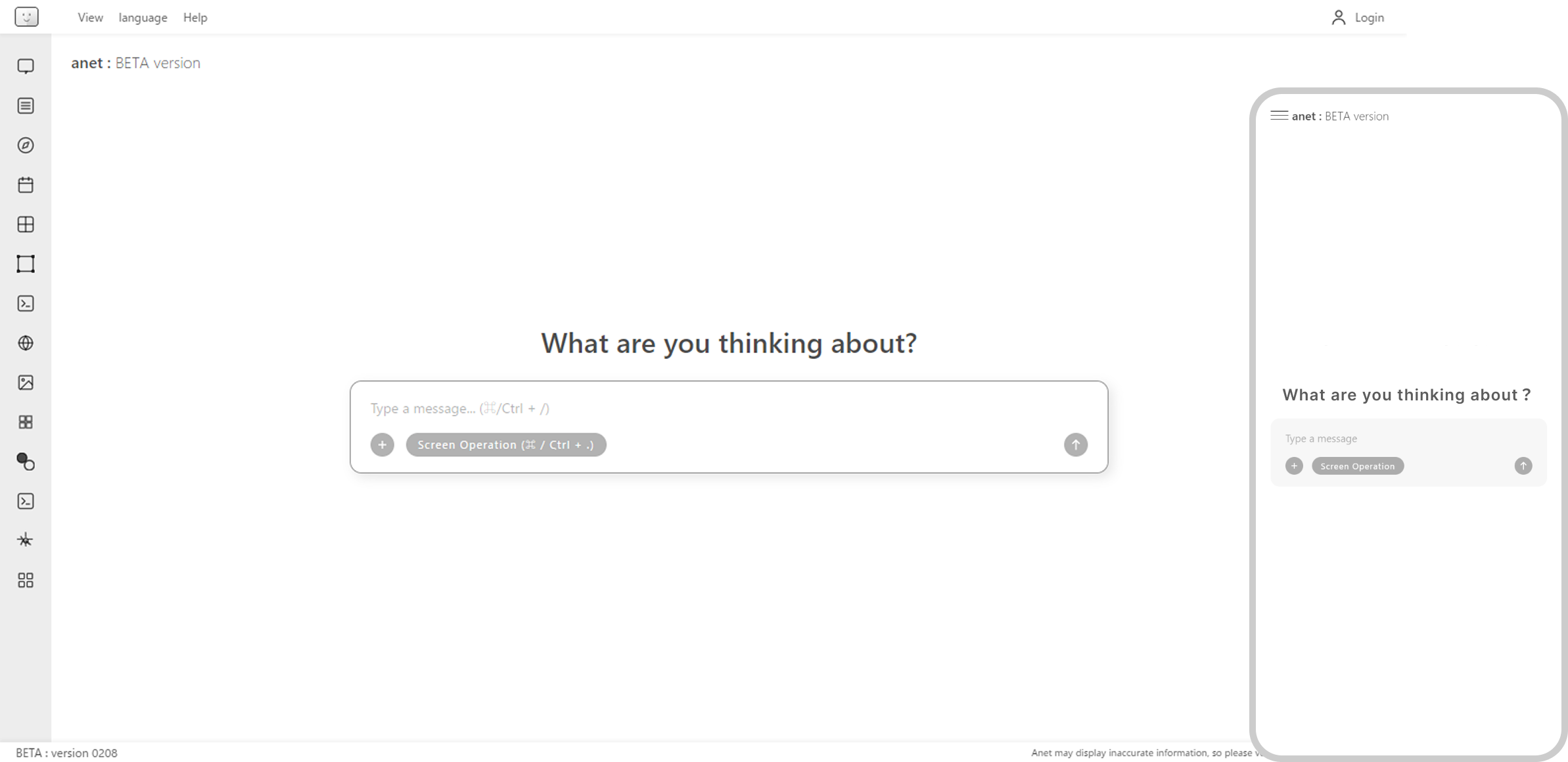
anet is an OS-type application with integrated AI.
Latest News
About anet
anet, which explores the vision of next-generation computing, features an innovative design that governs AI not as a mere extension but as an integral part of the OS. Unlike conventional AI tools, this system manages user context and memory on the OS side, connecting to AI as needed, preventing information fragmentation and enabling reliable dialogue. By treating AI models themselves as replaceable engines, anet's strength lies in providing a stable user experience unaffected by technological evolution. This goes beyond mere application development, presenting a new paradigm in computer science for controlling the powerful presence of AI. The role of anet as an OS is to complement the weaknesses of both humans and AI, connecting them within the same context.

Autonomous OS Architecture Governing AI Networks
1. Physical Permission Separation of AI Agents While existing AI apps delegate "execution rights" to AI, anet completely separates AI from the OS kernel (core). AI can send signals as "proposals," but the structure ensures that actual interference with the system is physically impossible unless passing through OS-side gates.
2. Protocol-Driven Behavior Control (Manual-Based Approach) AI behavior is controlled not by "prompts (requests)" but by "communication protocols (rules)" defined by the system. No matter what output AI generates, actions that do not match the "correct type" defined by the OS side are immediately invalidated, providing robust governance functionality.
3. Persistence of Thought and Sandbox File System User thoughts (compass) are assetized in a "dedicated area under OS management" that AI cannot directly rewrite. AI can "reference" this area but cannot "tamper" with it without OS permission, providing an isolated design that protects user assets from AI hallucinations (falsehoods).
4. Loosely Coupled Multi-Engine Orchestration Without depending on specific AI models, multiple AI engines are dynamically switched and managed as "components." Each engine is placed as an "independent slot" that cannot interfere with others, ensuring that even if one AI becomes unstable, the overall OS stability is maintained.
tools
Chat
Memo
Grid
Canvas
Code
Portal
Compass
Calendar
Image Generation
Gallery
go
The diverse array of tools prepared in anet—chat, memo, grid, and more—are not mere convenience features. While they can certainly be used for organizing user thoughts, they are sophisticated multi-angled observation devices cleverly positioned to extract user thinking from different perspectives: "dialogue," "description," and "structuring." Each time users entrust their daily thoughts to these tools, a massive rendering machine operates behind the scenes, analyzing and integrating accumulated fragmentary data in real time. This is not merely an accumulation of records but a process that maps your intelligence into a dynamic "thought map," transforming everyday tool usage itself into an extremely precise computation for visualizing the entirety of knowledge.
OS that Maps Thoughts and Co-creates Transparent Intelligence
anet does not merely store users' fragmentary data but structures them to generate a "thought map" and operates it as the sole "source of truth" shared between AI and users.
1. Generation of Thought Map Automatic Data Organization: anet analyzes and organizes words, memos, and dialogue logs emitted by users in real time, generating a "thought map" that visualizes connections between concepts. Core of Personalization: The generated map is mounted (connected) to anet as the user's unique context. This allows the entire system to deeply adapt to the user's thinking characteristics and become personalized the more it is used.
2. AI Operation Based on the "Map" Information Synchronization and Execution: AI engines within anet read this "thought map" as the highest priority reference source (part of the manual). Elimination of Arbitrary Imagination: Since AI answers and executes based on facts and structures drawn on the map, AI-specific "arbitrary speculation" and "hallucinations (falsehoods)" are structurally suppressed.
3. Transparency: Breaking Free from the Black Box Visualization of Thought Processes: It is always made clear why AI gave that answer and which "map" information it referenced. User-Sovereign Governance: Since AI's judgment criteria exist in a visible form as "the user's own thought map," high transparency and reliability regarding system behavior are guaranteed.
External OS of Thought that Induces Individual Singularity
anet's goal is not merely the pursuit of convenience. Its true aim is to continuously update users' thought maps, break through the limits of human intellectual capacity, and induce singularity (technological singularity) at the individual level.
1. Co-evolution That Breaks Through the Limits of Thought Existing AI is merely a "consumption target" that answers human questions. However, anet reflects users' thought maps like a mirror, has AI read them, refines them further, and returns them to users—repeating this "recursive process." Through this loop, user intelligence expands exponentially, leading to ideas in dimensions unreachable alone.
2. Intelligence Platform Optimized for the "Individual" While society as a whole fears the threat of singularity, anet reclaims that power for the "individual." By making user-unique thought maps the premise (source), AI transforms into the strongest thinking engine specialized for "you," not anyone else in the world.
3. Absolute Trust Born from Transparency Why can such a bold goal be set? It is because anet always exposes AI's judgment basis before users' eyes in the form of a "thought map." By eliminating the black box and creating an environment where AI can be 100% controlled as an extension of one's own intelligence, this transparency becomes the sole foundation that allows humans to safely transcend their limits.